If you haven't read it already, you might want to start with
Day Zero.
Saturday, 24 September 2011
Next morning we deposited our non-camera bags in reception for them to start what turned out to be their 8 hour journey to the Mara. After breakfast it was back into the matatus for the short transfer to Wilson airport. Traffic was much more free-flowing on Saturday morning and the trip took about 15 minutes or so. Most of our party only had our camera bags with us and we stood around trying to make them look as light as possible. The baggage weight limit on the
Safarilink flight to the Mara is 15kg which is why it's so important to send pesky necessities like clothes by road. My own camera bag weighed 15.3kg, and those carrying more serious kit like Mark's 600mm, 200-400mm, 24-105mm and three bodies weighed in at well over 20kg. After weighing a seemingly random selection of our bags all together they were happy to let us on board without any trouble.
 |
| Our plane, on arrival at Ol Kiombo |
Once we were issued with our boarding cards (colour-coded laminated pieces of cardboard), it was then back into matatus for a short trip back half way around the airport perimeter from Safarilink's check-in building to the actual departures & arrivals building. There's no posted list of departures in any specific order, so we ended up standing around on the tarmac watching the planes being prepared and the lucky yellow and then black boarding pass groups being led to their planes that were ready first. Most of Safarilink's fleet seems to be
Cessna 208 Caravans but which plane they actually use depends how many passengers they have for a particular destination on any given day. There were enough people heading for our airstrip with us that we got to fly on a
Bombadier Dash 8 with a capacity of 36 passengers. The flight was quick (about 35 minutes) and smooth and before we knew it were on the ground at the Ol Kiombo airstrip and being met by our drivers from
Entim.
From the moment you drive away from the airstrip it's immediately clear that the Mara is very different from any of the southern African game reserves I've visited. Most obviously, the terrain is much more open than South African bushveld. There are patches of riverine forest, but for the most part the area is predominantly open grassveld with isolated trees here and there. In fact, viewed from the air, it looks like trees are vastly outnumbered by termitaria.
 |
| The Mara from the air. The pock marks are bare areas around termite mounds. |
 |
| Brian Halls, happy to be in the Mara. |
The other major difference is that there are animals everywhere! We were unlucky with our timing in that the bulk of the wildebeest migration had already left the Mara in early September this year, leaving just their flies behind. Despite the absence of 95% of the migrating beasties, it's still difficult to find anywhere where you can scan the full 360º of horizon around you without spotting wildlife of one form or another. In our first hour in the Mara, en route to our camp, we'd already seen a leopard, parts of the local Entim lion pride and their already-abandoned breakfast of zebra which had become a vulture magnet. Oh, and tons of wildebeest, zebra, Thomson's gazelle, impala, topi and giraffe of course, but since they're so plentiful they all tend to blend into the background, and stopping for them doesn't happen often unless they're doing something particularly interesting or presenting themselves in great photographic light.
 |
| The first leopard sighting |
In my frame of reference any leopard sighting is generally special enough that you'd want to sit with the leopard for ages even if it's just sleeping under under a bush. When we left our first leopard sighting after 3 or 4 minutes of watching it sleeping in fairly dense cover, I hoped it was because our driver was confident that the leopard wasn't going anywhere soon and that we'd have better sightings later, but I had my doubts. Fortunately I needn't have worried, but more on the leopards later.
 |
| Some of the Entim lionesses & cubs. Note the lioness sleeping in the tree. |
 |
| It's hard work being cute when flies interrupt your nap time. |
 |
| Dozing mother & child, with visitors. |
 |
| One of the two Entim pride males. |
 |
| Ye Olde Lion Portrait. |
The trip to the camp was also an opportunity to warm up the camera trigger finger and the photographic brain. Not having had much of a chance to shoot much in the past few months I soon discovered that I'd become a bit rusty and so I had plenty of disappointments amongst my pics from the first day, mostly due to poor framing. I was shooting too tight - clipping the tips off vultures' wings and cats' tails or not leaving myself enough room to fine-tune the composition in post. Fortunately I caught most of my bad habits in the first day's pictures and mostly managed to avoid repeating them in the days that followed.
 |
| Marabou Storks & Rüppel's Vultures |
 |
| White-backed Vulture on final approach - one of many clipped-wing shots while my brain was rusty. |
 |
| Rüppel's Vulture touching down. No crop problems this time. :) |
We arrived at camp at around 11:30 to be met with a drink of orange juice and a very welcome cold towel. After our tents were assigned there was a bit of time to settle in and enjoy a first Tusker before we sat down to a delicious three course lunch.
 |
| David & Aaron in the tent. |
|
 |
| Lunch table & lounge tent. |
|
 |
| Our tent exterior. |
|
After lunch we had a bit more time to kill before we headed off on our afternoon safari at about 3:15.The highlight of the afternoon was a sighting of a male leopard who was initially lurking in cover and seemingly stalking a dik-dik. Unluckily for the leopard, the dik-dik spotted him and gave him a wide berth and sounded the alarm. The leopard stayed focused on where the dik-dik had been, so perhaps he was actually more interested in the impalas that in the vicinity or perhaps he just didn't want to acknowledge that the dik-dik had outmanoeuvred him.
 |
| The leopard pretending not to notice that the dik-dik has noticed it. |
 |
| No dik-dik for din-dins. |
It's always hard to tell how long one spends at a great sighting. It felt like 5 or 10 minutes, but judging by photo timestamps it was almost half an hour before the leopard gave up and broke cover, loping off between the many vehicles that had arrived by then.
We stayed with him for the next 20 minutes as he moved on a few hundred metres at a time, pausing to assess his hunting opportunities or just to shake off the flies that were clearly more annoying to him than the vehicles.
Along the way he treated us to an array of facial expressions that Jim Carrey would be proud of...
Eventually he'd had enough and took to a tree, which was our cue to move on.
By this time it was quite overcast - not the greatest photographic conditions. On the one hand, shade is your friend when you're photographing birds with high contrast plumage that are difficult to expose correctly in bright light, but on the other hand too much shade means that you're battling to collect enough photons to excite your camera's sensor. Both this lapwing and starling are classic high-contrast challenges...
 |
| Spur-winged Lapwing @ ISO 1250 |
 |
| Rüppel's Starling @ ISO 3200 |
 |
Thomson's fly magnet gazelle. |
 |
| Gathering storm cell |
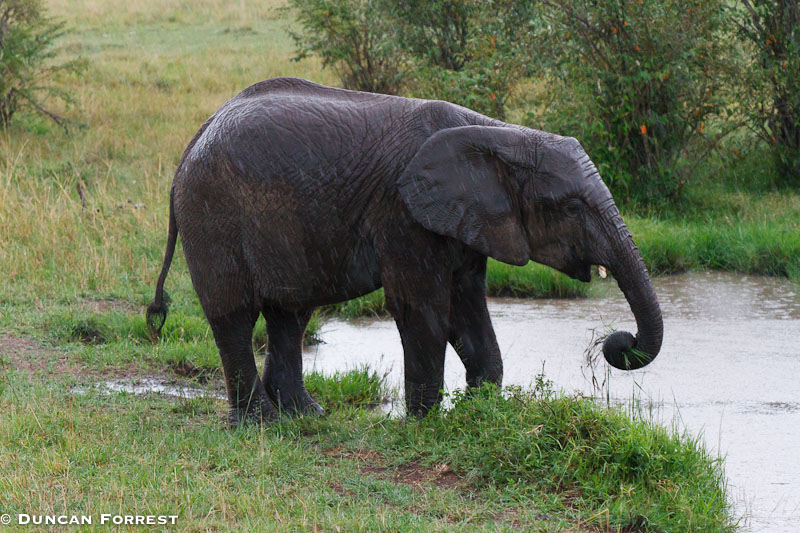
By 5:30 it was raining, and most of the animals were lying low, but these elephants made for a nice dark background against which to capture falling raindrops.
 |
| Rain drops @ 1/250s with a pachyderm backdrop. |
 |
| Elephant yoga |
Near the elephants we found the two-mane coalition that runs the Entim pride looking rather sorry for themselves in the rain. This turned out to be the only time we saw them together.
 |
| It's tough to look imposing when you're having a bad hair day. |
By 6pm the light was fading fast and we headed back to camp, with short stops for some well-positioned elephant against the skyline and a few minutes with the Entim pride's young cubs we'd seen earlier in the day.
 |
| Twilight Tuskers (the non-alcoholic version). |
Back at camp it was time to colonise a few square centimetres of table top to charge up and download before the first of many great Entim dinners. All in all, a great start and a very full first half day in the Mara!
 |
The charging table in the lounge running at about half peak capacity.
Ready for more? Next up: Day Two. But first, don't forget to leave feedback below!
|